On September 30th each year, Canadians and the federal government, in collaboration with Aboriginal peoples, commemorate the history and legacy of residential schools and honour the survivors, their families, and communities for the National Day for Truth and Reconciliation.
September 30th was chosen as the date for the holiday because it builds on the grassroots movement Orange Shirt Day, which is a day to remember the legacy of residential schools and move forward with reconciliation. September has historically been a painful month for Indigenous families and communities because it is the time when children were separated from their loved ones and communities when they went back to residential school.
Resources for Indigenous Peoples
Indian residential school survivors and family can call 1-866-925-4419 for emotional crisis referral services and information on other health supports from the Government of Canada.
Indigenous peoples across Canada can also go to The Hope for Wellness Help Line 24/7 for counselling and crisis intervention, toll-free at 1-855-242-3310 or in to the online chat.
Resources for Learning
The W̱SÁNEĆ Leadership Council has launched a new area on their website to give non-Indigenous people information about the history, language, culture, and land (including Territorial Land Acknowledgement) of the W̱SÁNEĆ people. Please check out Resources for Settlers here.
The South Island Powwow Returns to Royal Athletic Park September 30, with gates at 10:00 am, grand entry at noon, and events continuing until 8:00 pm.
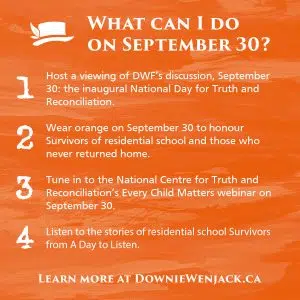
The Downie Wenjack Fund has some other ideas of how you can spend your time on September 30.
For more, learn about reconciliACTION on their website.
Read the report of the Truth and Reconciliation Commission (PDF) and commit yourself to the actions in it.
Educate yourself. Dig into the materials at the National Centre for Truth and Reconciliation.
Check out this free handy map of First Nations territory in Canada.
Support the Victoria Native Friendship Centre.
Donate to residential school survivors in British Columbia.
Take the 215 Pledge and be a voice urging Canada’s leaders and decisionmakers to take five concrete actions towards reconciliation.
Be a Settler that takes Action!